The Horn Book
This poetry collection opens with an explanation of its invented term wordspinner: “A poetry form inspired by a Nikki Grimes wordplay exercise. It seeks to define a word by spinning together the sound of the word and the function of the word. The only rule is that the first line...must end with ‘word.’ Length varies. Rhyming optional.” Welcome, for example, is “a smiling word, / it wraps its arms around you. / It says, come in! come in! / Let me show you / my world.” The book does just that, first introducing an array of types of homes (treehouse, loft, townhouse) with a wordspinner poem about each, and then giving each kind of home its own spread, with poems distributed throughout about places (parlor, bedroom) and objects (lamp, clock) found in those homes.
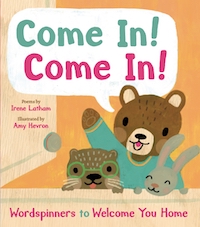
Inviting pastel-hued illustrations, done in acrylic paint on wood panels and digitally collaged, are populated with anthropomorphized woodland creatures and thoroughly preschooler-pitched. The bite-sized poems, too, should work well for reading aloud to young listeners, especially those that focus on sounds (loft: “a soft word, / it floats in your mouth / like feather-fluff”). Older children may get more out of examining words and understanding the wordspinner format—and perhaps feel at home enough to create their own wordspinners.
—SHOSHANA FLAX
Publisher's Weekly
Across this evocative dictionary of abodes, Latham’s poetry and Hevron’s creaturely artwork evoke the coziness of different homes and their trappings. An opening spread introduces wordspinner poetry as a form that “seeks to define a word by spinning together the sound of the word and the function of the word.” With assonant, alliterative, and occasionally rhyming appreciations, verse in 15 sections—largely organized into different types of structures (“loft,” “trailer,” “houseboat,” “yurt”)—identifies elements of home (“door,” “lamp,” “bed”) and beyond.
Wood grain lightly peeks through bright acrylic illustrations digitally collaged into scenes of woodland animals occupying a variety of spaces. Throughout this aptly sensorial grouping, the creators evoke “snuggle-up word” home as the place “where we learn/ to love.” Ages 4–8. (Oct.)
Kirkus
A series of poems devoted to the concept of home.
Latham begins with an explanation of the “wordspinner” poem, a form inspired by one of Nikki Grimes’ exercises: a poem that “defines a word by spinning together” its sound and function, the sole rule being that word must end the first line. Dozens of examples follow. Latham writes poems about various kinds of homes, among them the treehouse (“a high-up word”), the loft (“a soft word, / it floats in your mouth”), and the townhouse (“an upright, friendly word”). Later, she pens verses on the attributes or interiors of these homes. In a section devoted to the “Townhouse,” we learn that “parlor” is a “proper word, / a-we-want-to-impress you word” and that “lamp” is a “shaded word, / it brightens with the flip of a switch.” Many characterizations are spot-on: “Seashell” is a “surfswept word,” “swing” is “a swaying word,” and “piano” is “a songbird word / that tickles your tongue.” Sometimes, though, the words don’t seem to fit their location: Why is “lighthouse” the place for “closet,” “hanger,” and “shoe”? Still, the concept is easily grasped, the vibes are cozy, and the wordplay enticing; children will eagerly pen their own wordspinner verses. Gentle edges, easy shapes, and sherbet colors enliven Hevron’s naive art, featuring a cheery all-animal cast.
Verse that will inspire imitation. (Picture book/poetry. 4-8)