|
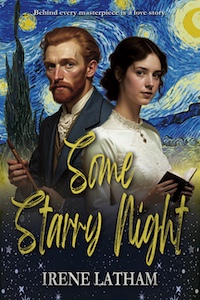
Some Starry Night
ISBN: 978196470830
Buy on Bookshop
Buy on Amazon
Historium Press
|
|
Readers’ Favorite
In Irene Latham’s Some Starry Night, in 1886, struggling painter Vincent van Gogh arrives in Paris, hoping the city can finally give him the artistic future that has escaped him for years. At the same time, Emily Dickinson secretly leaves Amherst after learning that Bright’s disease is slowly killing her and travels to France, determined to experience a life larger than the isolation that has defined her adulthood. When the two meet inside the Louvre, Emily is drawn toward Vincent’s restless vision of art while Vincent discovers in Emily someone who understands the private fears driving his work. Their connection pulls Emily into the unfamiliar world of Montmartre and pushes Vincent toward a new style of painting shaped by emotion instead of convention as both attempt to create something lasting before illness and separation overtake them.
In Some Starry Night, Irene Latham places Emily Dickinson beside Vincent van Gogh in Paris. The author does an amazing job of conveying the texture of the late nineteenth century through period details: Vincent taking newly available tubed paints into the streets of Montmartre to work outdoors for hours at a time, Emily enduring the limited medical knowledge surrounding Bright’s disease. Latham is methodical in character development, and we see how this transforms creation itself, particularly where Emily’s influence reaches beyond companionship and begins altering Vincent’s future in tangible ways. Of course, the title nods to one of the most famous paintings in the world, and Latham weaves it in, complete with a tragic ear incident. But it's the journey that matters here. Latham describes Montmartre cafés, filled with exhausted painters, and the flower-covered Duchamp garden where Vincent paints Emily’s portrait. Beautifully written and totally immersive, readers who adore literary and art history, romantic tragedy, and nineteenth-century Paris will adore this book. Very highly recommended.
—Jamie Michele
|
|
Kirkus
In Latham’s novel, painter Vincent van Gogh meets poet Emily Dickinson. Vincent van Gogh loves his new home in Paris, but while he admires impressionism and Japanese block prints, he hasn’t yet discovered his own style. Taking art lessons at Cormon’s atelier, the messy, rustic, and intense Vincent doesn’t fit in with the other younger, more sophisticated students. He tries selling his paintings to tourists as his younger brother, Theo, provides him with food, housing, and tuition. On a parallel track in Amherst, Massachusetts, Emily Dickinson also struggles to make an impact with her art. Former tutor Thomas Wentworth Higginson promises to use his connections to get Emily’s poems noticed, but he seems in no hurry. Considered an overly strong personality, Emily has become an eccentric recluse at the Homestead, and her life threatens to narrow further when she’s diagnosed with Bright’s disease and learns she possibly has only months to live. Gathering her courage, Emily joins her sister-in-law, Sue, on a voyage to Paris. Vincent and the much-older Emily spot one another right away at the Louvre; he notices her bright orange shawl folded around her like bird wings, while she’s attracted to his freckles and high energy. It’s a meeting of minds and hearts, as they have similar goals for their art (“What all people want…is a moment of time,” Vincent states). The setting of Paris plays a central role in the narrative, engaging the senses of the characters. The spring air smells of “star jasmine” and has an “energy…like heat lightning.” (Alternately, the “air tasted like plums.”) Emily, missing the flowers and birds of the Homestead, is charmed, saying of a Paris neighborhood, “This place is a poem.” Supportive Sue and Theo are allowed some character development—Sue’s unhappy about her husband’s affair, and Theo pursues a reluctant woman—but the main focus is on the two artists with the outsize personalities. Latham’s prose can sometimes feel overwrought; Vincent’s “shoes felt too large, his limbs liquid” when spotting his brother. Still, this portrayal of an unlikely love match between two people who never fit in anywhere is engaging.
A fanciful what-if that makes an unlikely relationship seem not only possible, but joyous.
|
Dare to Care
|
|
|